As a child, I spent endless hours of fascination over a toy stuffed frog, complete with a zip down its back. When you unzipped the frog and inverted the plush, the frog turned into a prince, its animal identity hidden in the toy whilst giving body to the metamorphosized prince. This model of transfiguration evidently captivated more than just an eight-year-old boy, fascinated with the mechanics of fabric. Bruno Bettelheim’s groundbreaking Freudian analysis of classical fairy tales considers the boundary between man and beast fluid and continuous, reading the frog’s magical transformation into Prince as a psychical shift in perspective of a maturing lover. It is, as Bettelheim argues, the mutating ideological apparatus behind the princess’ gaze which transforms beast into man and vice versa, entailing what Slavoj Zizek might call a shift in “parallax view”, causing the beautification of the beast or the bestializing of the beloved.
Michael Camille’s illuminating studies of representation and figuration in the manuscripts of Roman de Fauvel similarly brings to light the intriguing reversibility between bestiality and humanity. Chaillou’s satirical depiction of Fauvel, the power-hungry horse, undergoes a series of mutations in manuscript illuminations, appearing not only as fully bestialised, but also on a series of hybrid representations from incomplete metamorphosis to full human verisimilitude. In stark contrast to jongoluers and minstrely musicians depicted wearing beastly masks, the illuminations in the Fauvel manuscripts seem to suggest an epistemology of difference that is more than merely “skin-deep”. Chaillou draws from the Aristotelian tradition which casts the body as a vessel caught between the animal (sensuous) and the human (rational) soul, but aestheticizes this critical difference as one of masquerading inversion: Fauvel is a beast masquerading as a human, while the revellers are humans masquerading as beasts. Fauvel's own "false front" is merely an inversion of the mask, with the beastly side flipped on the inside.
The slippery division between lover and beast literally marks the artistic corpus of Guillaume de Machaut as allegorical “masks” in the menagerie of courtly lovers. Two works, Le Dit de l’alerion and Dit dou lyon come to immediate attention. In a comparison of these two dits, both male and female genders are equally presented as beastly beings: L’alerion centers the male (human) protagonist as a learned trapper of (feminized) hunting birds, whereas Lyon bestializes a homosocial network of male rivals vying for the affection of the island’s single (human) dame. In the latter, as Margaret J. Ehrhart opines, the human autonomy of the narrating “I” is threatened by his attraction to the island’s female inhabitant. Moved to amorous emotions, the narrator recognition of the “beasts” as potential rivals both casts himself above them while simultaneously implicates (identifies) himself in their company as one of them, competing under the gaze of the dame. A “kindred spirit” under the auspices of love thus bestializes himself by accepting his given subjectivity under the rules of courtship, acceding to the reduced status of beast in order to battle for his lady’s love.
Machaut’s L’alerion, however, suggests a different take on the subject of love and courtship in the game of fin’ amours. Ladies are bestialized objects of desire, falcon birds that have to be deceived into trapping – in order for the lover to better his chances of winning his ladies’ love, he must first prove a master of deception amidst the homosocial before emerging triumphant in the realm of the heterosexual. L’alerion reads as an extended didactic dit on the tips and tricks of courtly love, but above all, trickery is highlighted as a unifying theme. Trapping a prized falcon bird, the narrator declares, demands that the lover be “suitably equipped with tools” (60), preferably learnt in secret from more experienced lovers in the community of the homosocial. The lover “ought to regulate his thoughts, his actions, and his speech in a form that hides them well ... [and] must be on guard not to draw regard unduly” (51). Later in the dit, Machaut allegorizes the trap in which the lover lays for his beloved as a “small bird”, a bestialized object of affection to attract its prey:
“In this way should a lover act / who would, in his own interest, / set up a trap in such a way / that it appear agreeable, / arranged in the customary way [...] It (the trap) would contain the noble bird / used by most gentlemen / known as the ‘amorous sweet glance,’ / nurtured with the greatest care” (65)
By this double act of bestializing, the narrator implies that to “trap” the falcon, the lover must first offer himself as prey by presenting himself as domesticated beast (a “little bird”) of the courtly trade, disciplined and ennobled by “eloquent and courteous speech” (ibid). Hunter and hunted are obfuscated in Machaut’s clever twist of the bestial mask: lover captivates his beloved by offering himself captive in the first place. Advanced recognition of mutual deceit underlies the risky adventures of courtly love:
“It was thus good to deceive her / with this courteous deception, / for such deceit may benefit / the hearts of many, / when it turns / them towards the good, away from ill: / thus she who finds herself deceived / in such a way is no whit harmed.” (69)
In the same breath, Machaut warns against discarding the ideal lover’s disguise too quickly under the pressures of delayed consummation. To stay implicated within the discourse of fin’ amours, the rejected (or abjected) lover should “hold his peace and mind his task” since “too much talk ... does harm” and transforms his amorous “song ... to a sad lament” (66). Full admission into the economy of fin’ amours demands that the subject “suspend his heart in a true amorous suspense” and “faithfully ... await Love’s approval” (62). In other words, the subject is instructed to betray his true emotions, deceiving even himself in order to be taken seriously as a worthy suitor. The lover dons a “false front” of self-deceit, stoically enduring his lady’s apparent “discordant deeds” (54) for want of a delayed possible future in which both hearts are “so much in tune with one another and ... [thus] truly bound together” (56). The uninitiated novice too inexperienced to sustain his “false appearance” befalls a fate of madness, ousting him out of love’s orbit and into a self-indulgent spectacle of bickering bestiality:
“But even if he holds his peace, / if his heart should him dispose to show his sadness openly / when it intrudes upon his joy, / in manner or in countenance, / he makes his cause quite manifest / to others: this can well be said. / If he cries today, tomorrow laughs, / how he behaves will be remarked / and he can’t be excused for it. / In such behaviour danger lies / as much as if he’d spoken out ...” (51)
True love, the poet seems to suggest, is the prolonged effort of domesticating a wild beast rather than hastily divulging in immediate pleasures of the flesh. An illumination in Manuscript E (Fig. 1) accompanying the dit heightens this observation. Here, the narrative “I” of the dit is portrayed desiring the rare Alerion perched on the hand of one of two merchants. The potential poet/purchaser touches his wallet positioned suggestively near his crotch, while the two merchants gaze dangerously into each others’ eyes. Within the bounds of the frame, the horizons of socially accepted sexual boundaries are threatened by the “suspended animation” of the action – should the poet “purchase” the Alerion with his money (seed), the bird(s) propping the gap between male partners which neutralizes homosocial relations may disappear, leading both poet and merchants into unspeakably bestial acts. Fortunately, defiling the honour of the Alerion and compromising normative structures of sexual relations are not on the mind of the poet. Instead, he takes “great care ... not to attempt to buy the bird, for it was clear [he] never could make her [his] own in such a way.” (95)
Machaut’s oft-neglected Le Lay de Plour (Malgre fortune et son tour) paradoxically goes against his own advice against superfluous exposition. Apparently discarding the warning to keep one’s earnest animal desires at bay, Lay de Plour’s poet-protagonist throws off his “false front” in anguish, confronting – even accosting – his listening (or reading) audience with an all-too-honest disclosure of his heart. Arguably one of Machaut’s later composed works, Lay de Plour shares the same name as an earlier Lay, “composed” out of the narrative demands of Le Jugement du Roy de Navarre where, as penance for his misjudgement of feminine subjectivity, Guillaume the poet is sentenced to compose a lay. (For purposes of clarity, I will be referring to the lay accompanying Navarre as Lay de Plour and the later work as Malgre Fortune.) The musical, lyrical and rhetorical content of both lays, however, could not be more different. While Lay de Plour concerns a grieving feminine “je” mourning over the death of her beloved and the passionate tortures which the memory of her departed inflicts, Malgre Fortune depicts a rejected lover fallen from the vestiges of fin’ amours grace.
Written in 12 standard versicles, ouvert-clos structures and a recapitulation of the opening incipit up a perfect 5th in the 12th verse, Machaut’s poet-protagonist in Malgre Fortune directs his mournful aggression against his beloved, and against the pressures of performative “false fronts”. In contrast to Lay de Plour, the declamatory “je” does not wish to find aesthetic “life” in a “book”. Rather, the poetic “je” establishes himself as authorial source of the musical and lyrical, pronouncing that he wishes to make:
“De mon amoureus labour “From my amorous labour
Un piteus lay A piteous lay
Que je nomme et nommeray That I am naming and shall name
Le lay de plour” The lay of weeping.”
Both lays, however, parodies the craft of lay-making by foregrounding the writing process instead of the finished product. An aesthetic excess haunts both lays, denying them a sense of closure and self-referentiality. While Lay de Plour’s female protagonist continues articulating her desire to be enshrined in writing long after the writing is brought to completion, Malgre Fortune’s lovesick poet declares that he will write a “lay de plour”, but never succeeds in completing the actual poem. Instead, Malgre Fortune tracks the poet’s pseudo-biographical transition from uncouth, maddened beastly lover to smooth, refined subject under the laws of fin’ amours at the cost of the lay itself. Listening to his narcissistic ramblings, the poet discovers his own deficiencies and abandons the project of the Lay midway, seeking forgiveness for his vulgar excesses and humbly acceding to perform the “false front” of a refined lover. Put another way, the poet is saved from the cause his solipsistic artistic inspiration precisely by his artistic enterprise: his impulse to etch the lay upon the back of another sacrificed beast (the parchment) helps him to externalize (materialize and therefore stage) the gaze of his lover, revealing to him his own inner beastly qualities. Only by doing so, as Lacan might posit, can the poet comport his performative structure to the gaze of his beloved, inverting the bestial mask to transform himself into a well-subjectivized object of desire of the “Other’s desire”.
Lamenting that the object of his affection has forbidden the poet to “pass the threshold of her dwelling”, he bemoans the maddening imprisonment of his solitary thoughts, claiming that Love has done him wrong for his “humblement l’endure” (“humble enduring”), causing him to live “contre nature” (“contrary to nature”) in “desconfiture” (discomfort). Perched on the verge of despair, the poet decries the necessity of such “false fronts”, although later he pines:
“Si que pleindre “Thus I do not wish to plain
Ne complaindre or complain
Ne me vueil plus ains vueil findre more than I wish to fain
Que mi doloureus complaint that my sorrowful complaint
Soient maindre might be less
Puis qu’attaindre” than that which I attaint”
His song of expressive detesting becomes one of self-reflexivity, a project of realigning himself with the necessity of his performed “false front” for fear of further making a spectacular beast of himself in the social presence of others. Likening his song to “Li cignes contre sa mort / se reconforte en chantant” (“the swan before his death / [comforting] himself in singing”, the poet ruminates over the dangers of unbridled beastly gestures, noting that such unrefined (in)versions of the animal-mask makes a fool of him. Indeed, he berates himself for “je parole contre moy” (“speaking against [himself]”), having committed the sin of disclosing his heart’s lamentations. In verse 11, the poet then commits himself to Venus, seeking forgiveness for “pechie de la rudesse” (“the sin of crudeness/rudeness”) by his narcissistic outburst. Vowing to comport himself to the role of stoic lover, the poet ennobles his activity through the exercise of humanly restraint, domesticating his bestial side by inverting the mask, although, paradoxically, betraying his essential emotions. On the other hand, the torture of exile from his beloved’s quarters is sublimated into gentlemanly gesture of nobility and refined social stature, ennobling the poet within his immediate community.
Yet, Machaut clues us in to another hidden detail of the poet’s well-camouflaged relations with the lady. In verse 7, the poet berates Love for turning against him, “me fait plus contraire Qu’Alixandres ne fist Daire” (“[making] more against [him] than Alexander was ever against Darius”). In this rhetorical slip-of-the-tongue, the poet (perhaps unwittingly) allies himself with one of history’s best-remembered losers, famous for his cowardly acts of flight from battling with Alexandria. Has the poet indicated yet another “false front” he has adopted, duping listeners by their undiscerning leap to sympathy? Is the poet not secretly confessing that the truth regarding his banishment from his ladies’ territories is not in fact a red-herring, that his plight is caused by his own cowardice and lack of courage to confront his lady face-to-face? After comparing himself as a contemporary Darius, the poet explains:
“Et si ne m’os traire “And so I dare not pull
Vers son dous viaire against the sweet image of her
Pour mes maus retraire to drag back my ills,
Car mieus me vaut taire for it is better for me to keep silent
Qu’a li plus desplaire than to cause her further displeasure,
Qui me puet faire et deffaire.” who can make and unmake me.”
The poet’s true dilemma, is twofold: he is both unable to digest harsh reality of rejection and cannot bear to bring himself under the direct gaze of his lady who “can make and unmake” him. It is the bestial version of his lady and her de-subjectivizing gaze that “se taindre et destaindre” (“makes [him] lose courage and destroys [him]”), a two-faced (even hybridized) chameleon that collapses beauty and beast into a single continuum, though on opposing sides. This, Slavoj Zizek reminds us, is the crucial ambivalent nature of the objet petit a raised to the level of das ding (“The Thing”). For Zizek, the “censoring” (displacement) of the Lady as a form of power-discourse authorised by an overriding “Big Other” affects:
“[Not only] the status of the marginal or subversive force that the power discourse endeavours to dominate but, at an even more radical level, splits the power discourse itself from within.” (31)
That is, the lady is the monstrous loved-other of the split objet, the traumatic void about which the entire support of the lovesick subject is structured, regulating his access to jouissance (a position between pleasure/pain, between laughing/crying (L’alerion, 54). By embracing his animal side, the poet dislocates himself from the Symbolic of fin’ amours, “traversing the fantasy” and becoming abject-subject of the Freudian death drive (42). The teleology of the subject’s reidentification with the Symbolic order of fin’ amours and triumphant re-emergence as “fully constituted” fin’ amours subject can thus be read as the inversion of Zizek’s “traversing the fantasy”, literally a “regression into fantasy” by logical sleight of hand, finding refuge in the fantasy that he may be someday “addressed” by his beloved and have his pangs of love finally cured, or, at least elevated as an honourable, faithful lover amongst his peers.
Musically, Machaut effectively portrays the poet’s “regression into fantasy” via a teleological trajectory dominated by two musica recta hexachordal poles of F and C respectively. Figure 2 shows a reduced voice-leading graph of the discrete pitch-based “cells” that compose each successive verse. Verses 1-5 are dominated mainly by a three-note descending figure A-G-F, strengthening the tonal importance of F as a cadential port-of-call, reinforcing the initial authority of the recta F-hexachord with numerous inflections of B-fa as well as its strategic participation in ouvert-clos relations in verses 3,4,6 and 7 (see figure 3 for a condensation of final, ouvert-clos and incipit features).
From verses 7-12, however, an 8-note voice-leading figure (F-E-D-C, Bb-A-G-F) begins to fill out the pitch progressions. While potentially reifying the controlling feature of a diatonic mode centred about F, it is also possible to consider the octachordal descending figure as an overlapping of both the F (F-G-A- Bb-C) and C (C-D-E-F-G) hexachord members, navigating the shifting tonal terrain to a higher musical goal. In verse 8, a sudden increase in B-mi population density over B-fa tips the tonal balance in favour of the C-hexachord, overriding the F-hexachord’s organizing role. Furthermore, the involvement of B-mi in both verse 8’s ouvert and clos procedures shifts hexachordal gears, stabilizing C as a new gravitational centre of attraction. Indeed the proceeding verses confirm this pole-swapping: verse 9, 10 and 11 consist of a repeating G-F-E-D-C figure, with C being the clos final for verses 5 and 8-12. Rhetorically, it is as if the subject migrates to the ‘natural’ recta C-hexachord by forfeiting his drive-centred insistence on B-fa (F-hexachord), precisely “naturalised” by means of embracing a disciplined subjectivity in the Symbolic of fin’ amours.
More curiously, however, are the random interjections of an F# ficta note, belonging neither to the economy of the B or C-hexachords. Springing to declamatory prominence in verses 2, 9 and 12, the F# ficta appears like a foreign bestial body, haunting the (bodily) sanctity of Malgre et Fortune’s dominantly recta circuit. Upon close inspection of manuscript sources, the mystery deepens. Based on existing evidence, Machaut’s Malgre Fortune survives in four sources: MS A, MS F-G, MS E and MS V-G. Of these four sources, only MS A, F-G and V-G contain the poem with notated music, usually found in the Lays section of the manuscript. MS E, presumably compiled after the composer’s death, interestingly attributes Malgre Fortune to the end of Machaut’s Le Livre du Voir Dit (“True Story”), though it survives without any notated music to the poem. Machaut’s other Lay de Plour is linked directly to Navarre by means of narrative, but no other surviving manuscript except MS E makes the attribution of Malgre Fortune to Voir Dit. Though it is possible that Machaut later decided to make such a connection, we have no evidence available to suggest so, or otherwise. If, following the compiler of MS E’s suggestion, we decide to read Malgre Fortune against Voir Dit, one is left with two works querying and queering the nature of “truth” by means of “false fronts” and masterly deception.
Wednesday, May 20, 2009

Tuesday, March 31, 2009
To my songbird, in memory of Judy Bethea
Allie's email came last night, but I only checked my inbox this afternoon. It was only then that I realized that a large part of my life had suddenly dissolved and disappeared. Judy passed away peacefully at 5pm on the 30th of March, 2009 from repeated stages of cancer. And this was the one Spring Break that I had to be away from New Orleans, away from Wesleyan, tucked in the confines of the Bod or the faculty library chasing images and words rather than singing with the boys for Judy. The second Spring Break, before we drove up to New Orleans, Judy had emailed me with a request to perform a song for Bill. Her secret idea was to rehearse surreptitiously by herself before the Spirits materialized, then when we did, we'd sneak to the hall downstairs - me on the piano and Judy on vocals - to hammer out a love surprise for Bill. That song never came to be; when I arrived in New Orleans, Judy was feeling far too weak to sing. Even so, she still mustered the strength to resonate the earth-shattering solo on "change in my life", which she always sang with the Spirits, year after year. Her other request was that we sing "Lullabye" at her funeral. We were always ready to perform that number (as we had done year after year); in my freshman year, Judy cried while we sang. In my Sophomore year, she held back the tears, overcoming something that we could not bear witness to. It was with this email that I realized what she had finally overcome. And I think she was ready to go, unbeholden, with a rigourous, beautiful song.
Judy is a songbird unlike any other. Her generosity unfailing, always excessive, always wordless with a hug you'd never forget. It is only befitting that we return the hug in song, indeed in lullabye, for all that she has selflessly given. Judy Bethea, an architectural historian of New Orleans - one of the best in the intellectual community - made it a point to force us into a van on a sunny Spring Break afternoon, and drive us right into the heart of post-Katrina devastation, impelling us to encounter the other side of human life. A reminder in our somewhat hyperactive celebration of academic freedom, other people were busy rebuilding their lives. These were the Spring songs she sang every year, songs that were enriching, soul-lifting, but at the same time realistic and mindful of our interventions. Her enthusiasm for life was contagious, her love for Bill examplary. I'm sorry, Judy, that I forgot what song you wanted to sing for Bill. If I had the means to reach back into the trough of emailing history before the Wesleyan server moved to the new gmail network, I would. But this sudden shift exhausted it all. I no longer have material momentoes of you, of us. But I have your hugs, your love, and most importantly, your song. Your song that transgressed whatever state of wear your body was subject to, your song that dis-articulated the most unrelenting of emotional states. Your song that ultimately became our song because you sang it and owned it.
In Medieval Bestiaries, there is a palpable gendered tension between two cultural manifestation of sung birds. One, as Elizabeth Leach points out, is the nightingale, the male counterpart to philomela which hankered out illogical melodies without rational vox. Yet the Medieval's fascination with the sung bird cannot resist moralizing and valorizing the nobility of life unto song. In Cassiodorus' account of the singing nightingale, he repeates fascination with the "tenacious spirit" through which song is made manifest in the "tiny" body of the nightingale, causing it to sing, even unto death. The nightingale kills itself through song. Another popular image which is paired with the nightingale is the Swan, and accounts of the beauty of the Swan's final song are rife in the Middle Ages. Yet a single Bestiary trumps these associations, one that is still found in the Bodelian library. It's author praises the laudible musical abilities of the nightingale, but strangely, likens it to the archetypal singing maiden who, through song, overcomes her physical tedium and accomplishes her task. The maiden transgresses her gedered body, considered weak and incompetent in numerous 12th and 13th century accounts of sexual divisions, seeking strength in her own song, and yet being elevated to the status of the nightingale's sweet crooning. Song was understood to be properly metaphysical, affective and penetrating. Judy's song always bespoke of a life that refused to be caged by physical limitations, a song that challenged while inspired. It is to your impossible song I look, Judy, because you've transfigured us in a way that will always leave our music wanting, empty, lacking. But we sing nonetheless, because you've taught us how we can precisely overcome ourselves, effecting a material "change in our lives", encouraging us to go out and do the same.
I love you Judy, and I know you're still singing.
Goodnight, my angel
Time to close your eyes
And save these questions for another day
I think I know what you've been asking me
I think you know what I've been trying to say
I promised I would never leave you
And you should always know
Wherever you may go
No matter where you are
I never will be far away
Goodnight, my angel
Now it's time to sleep
And still so many things I want to say
Remember all the songs you sang for me
When we went sailing on an emerald bay
And like a boat out on the ocean
I'm rocking you to sleep
The water's dark and deep
Inside this ancient heart
You'll always be a part of me
Goodnight, my angel
Now it's time to dream
And dream how wonderful your life will be
Someday your child may cry
And if you sing this lullabye
Then in your heart
There will always be a part of me
Someday we'll all be gone
But lullabyes go on and on...
They never die
That's how you
And I
Will be
Judy is a songbird unlike any other. Her generosity unfailing, always excessive, always wordless with a hug you'd never forget. It is only befitting that we return the hug in song, indeed in lullabye, for all that she has selflessly given. Judy Bethea, an architectural historian of New Orleans - one of the best in the intellectual community - made it a point to force us into a van on a sunny Spring Break afternoon, and drive us right into the heart of post-Katrina devastation, impelling us to encounter the other side of human life. A reminder in our somewhat hyperactive celebration of academic freedom, other people were busy rebuilding their lives. These were the Spring songs she sang every year, songs that were enriching, soul-lifting, but at the same time realistic and mindful of our interventions. Her enthusiasm for life was contagious, her love for Bill examplary. I'm sorry, Judy, that I forgot what song you wanted to sing for Bill. If I had the means to reach back into the trough of emailing history before the Wesleyan server moved to the new gmail network, I would. But this sudden shift exhausted it all. I no longer have material momentoes of you, of us. But I have your hugs, your love, and most importantly, your song. Your song that transgressed whatever state of wear your body was subject to, your song that dis-articulated the most unrelenting of emotional states. Your song that ultimately became our song because you sang it and owned it.
In Medieval Bestiaries, there is a palpable gendered tension between two cultural manifestation of sung birds. One, as Elizabeth Leach points out, is the nightingale, the male counterpart to philomela which hankered out illogical melodies without rational vox. Yet the Medieval's fascination with the sung bird cannot resist moralizing and valorizing the nobility of life unto song. In Cassiodorus' account of the singing nightingale, he repeates fascination with the "tenacious spirit" through which song is made manifest in the "tiny" body of the nightingale, causing it to sing, even unto death. The nightingale kills itself through song. Another popular image which is paired with the nightingale is the Swan, and accounts of the beauty of the Swan's final song are rife in the Middle Ages. Yet a single Bestiary trumps these associations, one that is still found in the Bodelian library. It's author praises the laudible musical abilities of the nightingale, but strangely, likens it to the archetypal singing maiden who, through song, overcomes her physical tedium and accomplishes her task. The maiden transgresses her gedered body, considered weak and incompetent in numerous 12th and 13th century accounts of sexual divisions, seeking strength in her own song, and yet being elevated to the status of the nightingale's sweet crooning. Song was understood to be properly metaphysical, affective and penetrating. Judy's song always bespoke of a life that refused to be caged by physical limitations, a song that challenged while inspired. It is to your impossible song I look, Judy, because you've transfigured us in a way that will always leave our music wanting, empty, lacking. But we sing nonetheless, because you've taught us how we can precisely overcome ourselves, effecting a material "change in our lives", encouraging us to go out and do the same.
I love you Judy, and I know you're still singing.
Goodnight, my angel
Time to close your eyes
And save these questions for another day
I think I know what you've been asking me
I think you know what I've been trying to say
I promised I would never leave you
And you should always know
Wherever you may go
No matter where you are
I never will be far away
Goodnight, my angel
Now it's time to sleep
And still so many things I want to say
Remember all the songs you sang for me
When we went sailing on an emerald bay
And like a boat out on the ocean
I'm rocking you to sleep
The water's dark and deep
Inside this ancient heart
You'll always be a part of me
Goodnight, my angel
Now it's time to dream
And dream how wonderful your life will be
Someday your child may cry
And if you sing this lullabye
Then in your heart
There will always be a part of me
Someday we'll all be gone
But lullabyes go on and on...
They never die
That's how you
And I
Will be
Friday, March 27, 2009
Sensuous/sensory politics: Auditory Blindness
In a recent article on Music, torture and Repair, Suzanne G. Cusik asks the perennial Gordian question that keeps scholars' heads a turning: "but is this musicology?" She replies firmly "no", but always working on the margins of disciplinary standards and means. The more my eyes skim devotional texts, architecture, manuscripts and artefacts of the 12th and 13th century, this single barb - not unlike Bruce Holsinger's torturouos neumes that "pick" and penetrate the flesh - digs deep into my own disciplinary concerns. "But is this musicology," I ask myself, wondering where the wonderful permutations of Sirenhood and medieval music-making off the page may somehow effect a clausula, that is, a "turn" in my own musical thinking, leading me back to aesthetically privileged realms of "the music itself".
Indeed perusing the "Other" of musicology, its sister faculties of embodiment (such as Gothic cathedrals, manuals, treatises and art) tend to interpallate my own desirous tendencies to wander off interconnected pathways, delving into cultural issues that give "flesh" to abstract formulations which tend to exist freeze-dried in the many mausoleums of medieval scholarship. But ignoring these modes of embodiment, these marginal issues that trouble the dividing lines between pure signifiers and menstrually-charged ones (as in the case of much feminist discourse) tends to emphasize an unfair advantage to textuality, marking the point of phonocentric decline. I am not, as Derrida might warn, suggesting a return to an epistemology of orality which privileges the phonocentric as a marker of cultural presence, but bearing in mind the ways in which the "extra-textual" precisely figures medieval or contemporary notions of music and musicality.
Echoing Carolyn Abbate, one should not attempt to continue driving a hard-and-fast barrier between doxis and praxis. Rather, one should be wary of how such distinctions are brought to bear on material practices by their very modes of embodiment, indeed how they are located (in all senses of the word) as mediated objects. The contested nature of the "book" in the 12th century Medieval "renaissance" (for lack of a better descriptive) articulates a mode of embodiment, a Darstellung if you like, in a culture caught between orality, literacy and multilingualism. Similarly, preserving (or inscribing) neumes onto a page tends to eclipse the actual process of decoding these neumes in performance, reading, or decoration. The material culture of these books, these media, demands a closer investigation into means of embodiment, and the fashioning of the Medieval (performative) body.
In discussions of musica falsa, for example, these very practices which were deemed vagrant in ecclesiastical liturgy cannot simply be lifted off a post-19th century romanticized conceptualization of the autonomous "score" as a placeholder or trace of some metaphysical Platonic essence, wafting amids the fronds of our historically-tainted imaginations. Indeed such a valorization of the written (the inscribed) is to forget that inscription was a somatic gesture that facilitated memory and recall (as suggested by Carruthers), and somewhat constitutes a case of auditory blindness that simply extrapolates what was "notated" back into that same, safe conceptual sphere of "music" that jostles with the like of Mozart, Beethoven and Chopin. Even as these neumes provided visual "hooks" with which to drag the sonic out of the orifices of memory (and out through another orifice, the mouth), we should be careful not to allow the mere "visual" to "sing" all on its own, for the imagined bodies we pump its logic through are none other than our own contemporary bodies, fastidiously fashioned by years of listening and acculturation. The neumes - the word - performs precisely what Medieval writers were wary about: postlapsarian corruption.
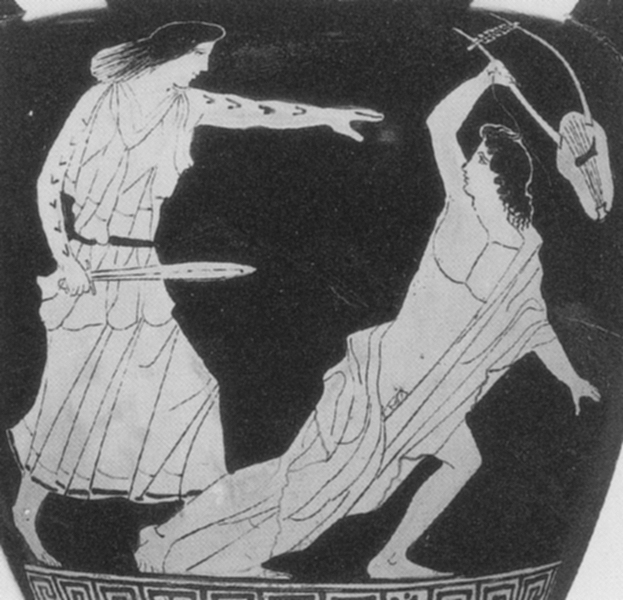
What bodies, then, should we accord these tracks? Imagining such vocalic bodies would be an excavatory task, albeit one frought with possible misinterpretation, crass assumptions and erroneous conclusions. But better give these voices flesh, I say, than recourse to yet another act of scholastic disembodiment. Perhaps it turns out that contemporary emphases on the empirical, that is, the systematic and notated, is but a fetishistic "blinding" of our scholastic condition to Orpheus's post-Bacchic condition. We choose to listen to the sweet, systematized and logical products of his severed head, while wearing dark glasses that filter out the horrific sight of his fragmented body. What unfathomable, abject secrets may lurk in the squirming entrails of Orpheus's horrific site of vocalic production becomes what Julia Kristeva calls the "semiotic", that pre-Oedipal choratic space of diffraction which contorts the health and safetly of our sanitized sanctuary of "the music itself".
Neither is the task to re-suture Orpheus' body to reflect our fantasies of normative sites of production. Indeed the journey at hand is to queer our eyes and ears not by backstepping to the authorial word, but by seeing with our eyes: reconstruing a sonograph of voice-body relations based on the already-queer features of the voice which functions simultaneously as a crutch of identification, and a "lost object", or what Lacan calls the objet petit a. By uncovering our own fantasies of voice-body suturing through an investigation of the "queer" medieval voice, I suggest that this may throw into relief our assumptions about the operation of music in culture and as a somatic artefact with destabalising ontological concerns. Vocalic body where voices mark the flesh and flesh taints the voice is charged empirical proof of our intrinsically "queer" features. One may imagine these "sewing surfaces" (or, as Zizek puts is, pointe de capiton) as cinemas which structure our phenomenal encounter with the world by masking an ontological lack or "gap" which forever threatens to throw the conceptual and the experiential out of joint. That is, a fundamental lack which threatens to sever our bodies and steal our voices, once and for all.
Wednesday, March 18, 2009
Sirenic nuns and porous cloisters

The mid 12th Century classical commenter Master Alberich of London initiated a moralizing spin on the antiquarian Homeric myth of Odysseus and the Sirens. Eschewing the highly fantastical, Alberich proposed a properly Christianized warning-tale:
“The wise man stops up the ears of his dependants, less they hear [the Sirens’] melodies, that is he instructs them with salutary teachings, lest they become entagled in secular delights. But he himself passes by bound to the mast, that is, supported by virtue, although he feels the enticements of the mutable world, yet he despises them and makes course for his fatherland of eternal bliss.”
Alberich of London could have easily been writing this cautionary fable for communities of the sacred as much as it was intended to threaten communities of the heathen. Clothed in highly gendered language, Alberich makes no small insinuation as to the semiotics of the “male”. Wisdom, the defining virtue of the “wise man” casts him as the (after)life-saving good shepherd that “stops up the ears of his dependants”, averting the lascivious calls of the Sirens to “secular delights” en route to an ethereal post-worldly “fatherland of eternal bliss”. The wise man, however, himself protected by “virtue”, is able to deflect the seductive call of harlotry by rejecting its interpellation. What is evacuated by means of this textual construct is precisely the presence or notion of the female body – only briefly indicated via popular contemporary associations of Sirenic voices to female performativity. The single-sided epistemological wall serving to delineate virtuous masculine wisdom simultaneously casts a long, ambiguous shadow over the dwelling properties of the “other”.
Others, like Isidore of Seville, Hugh of St Victor, Brunetto Latini and Eustathius the Homeric commentator, chose to conflate the vocalic qualities of Siren bodies with “lyre-playing harlots who deprived passers-by of their travel goods”, accounting for the ways in which performing harlots “consumed travellers’ money and possessions”. This phenomenon, explicated as early as the 3rd century survived long into texts of the 12th and 13th century, bearing heavy moralizing accents that warned of the dangers of seductive, secular song in clerical circles, and the fundamentally deceptive-inclinations of women in others. These fast-establishing epistemological walls that sought to discipline, contain and control the vocalic dangers of unknown bodily/musical territories were equally matched in architectural structures of division. The 12th and 13th Century, in particular, saw the rapid rise of medieval cities, facilitating the localization of Universities and institutions of cloistered learning. These new physical “walls”, as William Cook and Ronald Herzman note, did not merely foster a structural divide between subscriptive communities and bounded realms of knowledge access, but also encouraged the lively growth and exchange of knowledge-communities organized around disciplinary concerns. Theology, medicine and natural philosophy filled the halls of these new sites of learning, although contemporary concepts of autonomous disciplinary “walls” tend to obscure the fact that intense debate between each of these disciplines was the norm rather than the exception. Fuelled with an increasing body of translated literature distanced by geography and historical time, learned men commented endlessly on matters of the word, slaving hard to integrate disparate sources of knowledge into one harmonious, integrated ‘truthful’ whole.
For intellectuals residing within the structures of the Church, university walls were not always necessarily impervious. Instead, large intersections across institutional borders ensured that Clerics and other religious thinkers stayed in touch, challenged, and effectively affected the translation and dissemination of sources of theoretical debate. As Joan Cadden notes, the commensurability between university and monastic structures of learning rested on their historical parity:
“[Many] of the new tendencies – the interest in systematic science, the development of new formats for discussing it, the elaboration of settings for teaching and learning, and the execution of translations – had roots in the same monastic tradition which in the earlier period had cherished and preserved (if also diluted and fragmented) the remnants of previous transmitted classical learning.”
University scholarship thus supplemented and expanded upon a system that was well in place in Monastic pedagogical structures, resulting in a rich tradition of imported, exported and hybridized epistemological worlds. This also meant that early theological concerns, especially concerning the sexual division between man and women as articulated in biblical scriptures, became what Foucault calls “transdiscursive” sites of linkage and shared scholastic concerns. A number of important scholars such as Constantine the African and Hildergard of Bingen, for example, represented these transdiscursive bodies that were located across monastic and other “extra-sacred” sites of discourse. These writers, drawing on popular intellectual concerns of their time, expanded and nourished the corpus of theorizing the natural body, along the received lines of neo-Platonian, Byzantine and Aristotelian lineages, shedding light on the shadowed epistemology of the “other” side of the sexual wall, that is, the contested dwelling space of the “feminine”, which, in turn, defined or ensured the conceptual integrity of the “masculine”.
Despite obvious contradictions between a large body of theoretical material in circulation, notions of “sexed difference” were mostly concerned with marrying observed empirical “difference” with biblical and philosophical sources – attempts that led many-a-thinker to assume a fundamental essential nature of sexual polarities, informing, as it were, typological or characteristic “dispositions” of the either biological sex. Semantic binaries between hot/cold, dry/moist were popular categories that further extended the conceptual division of gender, though not always uncontested. Theorists such as Jacopo of Forli, Bartholomew the Englishmen and Albertus Magnus echoed popular views that linked such gender-specific qualities in a chain of signification that tended to cast “woman” as the miscreant, albeit derisive counter to the male:
“Women’s complexion is more humid than man’s. [The nature] of the humid receives an impression easily but retains it poorly. The humid is readily mobile, and thus women are unconstant and always seeking something new. Hence when she is engaged in the act under one man, if it were possible, she would like at the same time to be under another. [...] In short, I should say, every woman is to be avoided as much as a poisonous snake and a horned devil.”
Quoted from Quaestiones de animalibus –expositional lectures on Aristotle’s zoological works – Albertus Magnus forged a logical pathway linking empirically observed data with speculative biological thought. Such a descriptive procedure of claiming knowledge over the Other, as Edward Said reminds us, is a mode of power acquisition, a mode of description that operates through prescription, eventually articulating means of proscription. Indeed woman herself is prescribed as naturally unfaithful, guaranteed by her biological disposition that projects itself into cultural typologies. Coupled with the rise of Aristotelian translations and debate in 12th and 13th Century academic circles, “women” also became typecast as a less-perfect or imperfect manifestation of man – a concept that rested well with scriptural evidence of women’s hierarchical subordination to man, having been made from Adam’s rib. As with the writers of Malleus maleficarum, John of Garland emphasizes his pre-redemptive conceptions of Eva’s “imitators” in a language that “put the case in the open”, casting the unredeemed woman as “enthroned” in “death’s eternal kingdom”, her lips dripping with sensuously sweet “honey” although inspection through the de-rarefying faculties of reason reveal her “depths” as being “wormwood”. “Woman”, Garland suggests, “is lovely, beautiful – and destroys everything through lust.”
Matters became further complicated by the complexity of women’s biological rhythms to monastic scholars who tried to align natural bodily phenomena and notions of behavioural proclivities while remaining consonant with scriptural sources. Nowhere was this interplay of intertextuality more pertinent than in the discussion of the Menstrual Cycle in discourses of sin, salvation and medicine. According to Charles T. Wood, medieval menstruation became seen as a symbolic marker or a perpetual bloody reminder of Eve’s “original sin”, although Pope Gregory rhetorically absolved menstruation as being a sin-in-itself:
“A woman’s periods are not sinful, because they happen naturally. But nevertheless, because our nature is itself so depraved that it appears to be polluted even without the consent of the will, the depravity arises from sin, and human nature itself recognizes its depravity to be a judgment upon it.”
Menstruation became an important paradox for scholars who wished to clarify the messy logic between Eve’s original sin (postlapsarian epistemology) with the redeeming virginal qualities of Mary’s immaculate conception. This very fulcrum situated upon the “split” nature of woman carried immense theological weight regarding the salvation of mankind, with Mary symbolising the absolution of bodily-sin by her intrinsic purity. The 15th Century Malleus maleficarum (which notoriously conflated base womanhood with witchcraft and “carnal lust, [of] which is woman insatiable”) spells out the rising importance of virginity over the flesh as no less than an epistemic revolution enabling believers to rise above the postlapsarian corpo-reality of the body:
“[It] is true that in the Old Testemant the Scriptures have much that is evil to say about woman, and this because the first temptress, Eve, and her imitators; yet afterwards in the New Testemant we find a change of name, as from Eva to Ave (as St. Jerome says), and the whole sin of Eve taken away by the benediction of Mary.”
What follows is an instruction for preachers to “say as much praise” of Mary’s redemptive qualities as much as possible, highlighting the grammatical revolution from Eva to Ave that, as Robin Hass Birky suggests, not only elevated the embodied virtue of virginity, but made possible what he calls a “Marian rhetoric”. For Birky, “Marian rhetoric” aesthetically incorporates this conceptual fulcrum into a linguistic one as “the feminized analogues of the masculine incarnational and naked rhetoric”. That is, while discourse on Eve and the “original sin” caused a “fall” that dismantled “language’s efficiency” through filial signification, Mary’s (Ave) conception as virginal purity embodied in flesh “reunites language and meaning”. Writers such as St Jerome and John of Garland do not merely bespeak of the redemptive qualities of Marian virtue; this conceptual revolution is mirrored, even performed rhetorically through a more “ornamental” employment of language. Initially espousing a reduced, “plain”, “naked”, indeed exposing form of rhetoric, John of Garland reverses his previous position on base women when considering the need to reflect an elocutionary shift from Eva to Ave:
“With Mary’s body a fit container for Logos, the virginal purity of that body redeems language’s capacity to depict the truth. Metaphorized as everything but the physical body, the body of Mary purifies language, thus allowing ornamentation.”
What better way to manifest theological markers of difference between Eva/Ave and divisions between the crass secular and the redeemed sacred through dividing architectural structures. The physical walls of the cloister provided a conceptual boundary that delineated spheres of outside/inside, resonating with pre-existing conceptual binaries that functioned to keep these spheres separate and autonomous. For Lisa Colton, architectural bastions extended to mark the physical body of woman metaphorically, especially through the proliferation of chansons piesus and chanson de nonne in the 13th and 14th Centuries. Such musical literature, she shows, exemplifies valorised modes of chastity and sacred virginity by associating bodily boundaries with “walls and other architectural structures”. The dwelling space of the womb, central as it were to the tipping point between Marian virginity, cloister or monastic chastity and secular vices, was commonly described as an enclosure resembling the fortified walls of a nunnery. Fortifications inscribe boundaries of restraint on the human body both physically and conceptually, disciplining its inhabitants to internalize its structures as given psychic reality.
Notions of the voice in medieval accounts of singing and musicianship, however, tend to trouble the authority and impermeability of these cultural markers of difference. In particular, the equivocal nature of a woman’s singing voice was a musical site of ambivalence that appeared to be able to transgress such carefully constructed walls of enclosure. As Colton notes, one of the common tropes of threatened chastity was the “excessive use of a woman’s mouth for ‘display’ ... [and] a singing woman was often feared as seductive and ‘siren’-like”. This dimension of “singing”, for Richard Middleton, features what he calls the “vocalimentary canal” that conceptually links performative body (and all its sexed implications) with the apparent spectrality of the singing voice as a partially “lost” object ejected from the body. But beyond appropriations of St Augustine’s easy division between the “aesthetic” nature of music (managing and regulating psychic-somatic jouissance) and its “representational” instrumentality, Mladen Dolar calls attention to the voice’s “third level” of the “object voice” which stubbornly resists dissolution in the Lacanian order of the Symbolic. For Dolar, this spectral “object voice” corresponds to Lacan’s objet petit a (the “little object” or the “object cause”) beyond the Symbolic or the aesthetic, a “lever of thought as opposed to the anthropomorphic masquerade of thinking”. The coincidence of the “object voice’s” mysterious sensuality yet transgressing alien quality residing impossibly outside Symbolization is the key feature of the objet petit a – an impossible psychic object of pure alterity that produces a horizon of desire always out of reach, a desire that can never be satiated. As Todd McGowan describes:
“Desire is motivated by the mysterious object that the subject posits in the Other – the objet petit a – but the subject relates to this object in a way that sustains the object’s mystery [i.e. sustains his desire]. Hence, the objet petit a is an impossible object: to exist, it would have to be simultaneously part of the subject and completely alien.”
If the voice was desire-inducing as well as irreducibly alien, then such a feature must be deemed dangerous and subject to discipline under clerical law. Indeed the excessive in monastic music was viewed with a suspicious (if not ambivalent) eye by religious authorities such as John of Salisbury who asserted in his 12th Century Policraticus that music defiles the sacred when musicians ornament the instrumental, “showing off as it were, strive with effeminate dalliance of wanton tones and musical phrasing to astound, enervate and dwarf simple souls.” Paraphrasing St Augustine, John warned that “pleasure”, especially in the purely musical, was “the father of lust”. Performance should serve ecclesiastical means and inspire worship rather than stir the loins, the latter which served as a popular denunciation of secular music-making beyond monastic walls in the lusty merriment of popular Caroles. Perhaps it is no surprise that numerous chanson de nonne as explored by Lisa Colton and Suzannah Clark depict female subjects singing in lament of their bartered sexualities for religious chastity. A similar chanson of interest to both scholars is Joliement en douce desirree / Quant voi la floret / Je sui joliete / Aptatur, a four-voiced chanson that draws rhetorical strength from the interplay between what seems to be a nun wishing to be delivered of her cloistered life having found love, a monk debilitating on the consequences of his current love interest, and a youthful nun feeling the pangs of desire.
Inasmuch as architectural metaphor serves to articulate boundaries of possible transgression, Clark’s analysis of the musical operation of the motet traces a link between the triplum (the ambiguously sexed individual that declares “for naught this nunnery confine me”) which derives from another pre-existent chanson de nonne in trouvere repertory Quant ce vient en mai. The chanson of interest tells of “a young woman trapped in a nunnery” singing out to be rescued while the “narrator” who recounts the nun’s tale, “reports that the lover received her message and arrives to rescue her”. If this passage survives in Joliement en douce desirree’s triplum as a culturally-informed quotation that may have been identifiable to listeners, Clark proposes that the subject voice of the triplum, possibly a monk, “sings” the nun’s song both alludes to exclusive knowledge on behalf of the monk in a “seductive routine” that channels the spirit of trouvere chivalry. Furthermore, Clark speculates that the musical parity of both sources suggest that the nun of Quant ce vient en mai and the monk in Joliement en douce desirree “share a unity of purpose”, suggesting that the monk may turn out to be the rescuer of that nun, though piping his response through intertextual means by a voice that, quite literally, transgresses the physical wall of the individual, printed score or autonomous performance.
Sirenic powers of the singing voice to pierce, transgress and penetrate epistemological walls were mirrored by real concerns about the “object voice’s” abilities to elude the sanctified house of knowledge. A scandalous tale recounted by Gerald of Wales told of how a Canon and Nun in the double-house system of the 12th Century Gilbertine Order were “driven to desire” by hearing their singing voices on either sides of the gender-partitioning wall. Both blessed with an “attractive” singing voice, the penetrative powers of their voices caused them to escape “over the cloister wall the same evening”. Although Gerald of Wales equally attributes siren-like transgressive qualities to both the male canon and female nun, the follow-up punishment enacted by Gilbert of Sempringham is highly revealing – Gerald mentions how the nuns were punished by restricting their musical activities for mere “humble psalmody”, and shaving their heads beneath their veils to reduce their physical beauty, but, as Heather Josselyn-Cranson argues, there are disturbing omissions in the text:
“The lacunae in the text leave many unanswered questions: were the lovers caught? Were the canons also punished? The kind of psalmody to which the nuns were restricted is also unclear.”
Indeed no mention of punishment on behalf of the canons were mentioned by Gilbert, perhaps clueing us in on the perceived danger of female sirenic bodies over male ones. An interrogation into the Gilbertine Order, though admittedly the first of its kind to employ the “double-house” system which paired both sexes in the same physical space nonetheless used physical partitioning means to keep carnal temptation from escalating. Walls divided the female and male sections of the Church to “keep the canons from hearing the nuns, and the nuns from seeing the canons”, save a Pyramus-Thisbee-like aperture with which to pass the pax brede in as chaste a manner as possible. Severe disciplinary schemes were enacted to silence the sirenic call, including sections in the Order’s Institutiones which “entirely forbid all of [their] members ... the use of organum and descant, falsetto and pipeth at the Divine Office”, fortifying the heavy-handed control of what was usually deemed “emasculating” and “effeminizing” secular musical practices. The section on sisters in the Institutiones further declares that:
“We do not allow our nuns to sing [cantare] but absolutely forbid it, desiring rather that they chant plainly [indirecto psallare] in a spirit of humility, together with that ever blessed virgin, mother and daughter of almighty God, rather than corrupt the minds of the weak by lustful melody with that wicked daughter of Herodias.”
Although Cranson suggests that indirecto psallare may have come to signify a more “naked” form of plainchant (recalling John of Garland), the specific restrictions applied to the female sex bears testimony to the known powers of the “object-voice” and its uncontrollable order-defiling properties beyond the sacred, self-sufficient realm of the Symbolic. Indeed Nigel de Longchamp’s Speculum Stultorum (1179-80) in description of the Gilbertine Order may be read on two levels concerning the epistemological and architectural walls erected to reinforce each other:
“One house contains a quartered
Arrangement
Of canons, lay brothers, and
Sisters
Similarly divided.
The canons perform masses, and the
Sisters do the rest.
They fulfil the due service of the Office;
A wall separates their bodies, not their
Voices; as one
They sing psalms directly, without a
Tune.”
Indeed the very transgressive qualities of the “object-voice” continue to dismantle the body politic of the church by queering its epistemological fortifications – fortifications that split up an already fragmented symbolic understanding of “women” and the plural nun that, with her voice, slips between Eva and Ave, probing and interrogating the intrinsically porous nature of cloister walls and gender bastions.
Friday, March 13, 2009
siren embodiment... a primer
In Judith Peraino’s Listening to the Sirens, the Homeric myth of Odysseus’ encounter with the monstrous feminine provides a heuristic fulcrum in order to investigate the potentially queering effects of Siren-song though modern-day musical technologies. In order to navigate the seas without being captivated by the seductive death-bearing potentialities of the Sirens’ song, Odysseus binds himself to the mast of the ship and instructs that wax fill the ears of his rowing mates. The male body politic is thus disembodied, order is momentarily thrown into disorder and irrational solutions: Odysseus forgoes the use of his limbs while his men sacrifice their ability to hear their master’s commands. Though this method of temporary incapacitation eventually prevents their ship from being steered in the direction of the sirens – and into a certain watery death – Peraino shifts the focus of the myth to Odysseus himself. It is he, she notes, that hears/queers himself in the aural proximity of the Sirens, eventually condemned to lead a queer (after)life himself as the sole individual having lived the ordeal to tell it. Odysseus’ predicament is lonely knowledge; the veracity of his tale ironically falling on the same wax-filled deaf ears he initiated in the first place, untranslatable and fragile amongst a community of non-listeners.
In the recent years, musicological studies has indeed beckoned audiences to break the phallic mould of the wax and, restraining themselves as Odysseus did, hear the Sirens without leaping to premature conclusions. Although “Queer” musical culture is a category asserted not without heavy theoretical contestation, its sister platform, the largely influential body of discourse that constitutes Feminism and Feminist theory, seems to have fared little better. Resting on the assumption that “woman” as a unifying social community has been exploited by male-dominated discursive manoeuvres, Feminism’s project tends to look backwards and forwards at the same time; that is, drawing legitimacy from previous (historical) narratives of oppression, suppression and repression, and projecting these narratives forward in time to discuss how such proscriptive apparatuses continue to operate through the exclusion of “woman”, or how sites of resistance and subversive strategies may work to interrupt, interrogate and even dismantle such topologies of power inequalities.
Barbara Bradby’s somewhat angry examination of sampling women’s voice in dance music performs that analytical task, inquiring how theoretical utopias of gender egalitarianism might be better applied in emerging fields of musical technology. Decrying a well-worn binary opposition that all-too-easily reinscribes the category of “woman-as-nature”, Bradby selects theoretical iconoclast Dona Harraway and her musings on the posthuman cyborg body as a liberating enframing device in modern-day feminist dissections of musical technologies. Bradby singles out the disconcerting representational fragmentation in Black Box’s music video “Ride on Time” for its entagled nature in ownership, citation and copyright issues. Black Box’s “Ride on Time” stirred up a messy court case regarding its video that:
“showed a tall, sexy model from Guadaloupe … [one Katherine Quinol], ‘performing’ the passionate vocal line. But the rumour quickly spread that the vocals had been ‘sampled’ from a song called ‘Love Sensation’ by the American soul singer, Loretta Holloway.”
For Bradby, however, in addition to being wrongfully “sampled” under the umbrella of a different song, Loretta Holloway seemed to be “doubly ripped off” since the image of her body had been replaced by Katherine Quinol to create a cyborg-like composite of an hyper-sexualized performing body. This, Bradby asserts, did much to reinforce existing fields of discursive struggle including the “tyranny of slenderness” and so-called “acceptable body images for women” that dominate issues in scopophillic culture. Another song on the Black Box label entitled “Strike it up” pays tribute to this hypersexualized/monstrous hybrid by accrediting the “visual performance” of the video to Katrin Quinol while reserving the title of “lead vocal performance” to its rightful singer, Martha Wash. Does this cyborg-like hybrid parading in the face of hyper-reality recruit the male-gaze to reinforce proscriptive images of sexuality, gender and womanhood? The answer is overwhelmingly yes for Bradby:
“Once again, Katrin Quinol appears as the acceptable (because attractive to the male gaze) image of woman that can sell the voice of another woman that has been electronically manipulated by the male producers.”
And yet, Bradby reserves room for small praise, pointing out the way in which Black Box’s double accreditation signals a challenge to “the primacy of the visual in our everyday imaging of the body … [implying] that the voice is somehow ‘disembodied’”, while the “real” bodies of two separate non-cyborg women are indeed given prominence behind the fantasy of the virtual. Such a disjoint, as Richard Middleton argues, interrogates the very embodied notion of performance:
“especially through … a bodily intimate mechanism as singing – [which] is to put a body on display, to flaunt it, offer it up […]. Indeed, in this discursive formation, to own to a body already produces a place of subordination, creating the potential to suffer […]; meanwhile, the owners of discourse … are all words, bodies effaced from view no less than those of the record producers.”
Acknowledging the “spectral” economy of the fragmented being sutured together at the site of fantasy may denote (as is for Bradby), what Donna Haraway terms a “significant prosthesis” or a new kind of embodiment afforded by the site of suturing. But Middleton is also quick to point out the fragility of such forward-thinking gestures:
“listeners [may] immediately invent an imagined source for them [or have fantasy sites perform the operation of bodily suturing], drawing on the contours embedded in their experience of the operations of the vocalimentary canal: the phallus (male or female) writes, the voice translates, and the mapping of this process to the structures of anatomical and other visual and tactile knowledge describes exactly how the sensuous and the symbolic create each other, through the Derridean networks of ‘dissemination’ and ‘invagination’.”
What is at stake, thus, is what Baudrilliard warns of as “integral reality”, or the collapse of the real into the virtual – the point of ultimate commensurability where pure virtual fantasy acquires a sheen of the real more real than the real itself. Perhaps Bradby’s criticism bespeaks a horizon by which fantasy hypersexual Quinol-Wash cyborgs bleed into the parameters of lived embodied experience to announce (voice) new forms of exclusions. The question, for either authors, is one of “authentic” voice, that is, behind the muppet-like flailing of fantasy-creatures, who supplies the words – whose authorial voice speaks? Odysseus, or the men with wax-filled ears? This perspective, however, assumes that there is an ever-present, situated panoptical Big-Other that usurps the complexities of modern day technological assemblages, assemblages that figure into the assembly-line of musical-cultural products and, as Nicholas Cook suggests, by-products. This Big Other attribution of the phallogocentric (to use Irigaray’s formulations), skirts around the fact that, like Irigaray’s metaphorical women, the Big Other is an Other that is not one. Indeed, hard-and-fast feminist accusations of phallogocentrism tend to forget that entire economies of gender are occluded by their epistemological enemies, throwing the male body into crisis as well.
To put a spin on the original question is to investigate how emerging musical technologies “speak back” in sometimes unintended ways, troubling both the normalized “male gaze” as well as the apex at which the feminist gaze returns. Nicholas Cook’s groundbreaking analysis of Madonna’s “material girl” throws questions of ocular-centrism into musical relief by attempting what he terms a “musicology of the image”, showing how purely “musical” attributes inform and penetrate the very autonomy of the image in an MTV. For Cook,
“There is, in effect, a collision between two competing hierarchies, […] the result is to destabalize the meaning of the words and, through them, the closure of the song as a whole. The pictures, in short, serve to open the song up to the emergence of new meaning.”
The semi-sonata altering between two Madonna image-themes which Cook calls “Madonna I” and “Madonna II” blur the distinction between narrative diegesis and fantasy performance space though functioning to keep these dimensions wholly separate. The ultimate effect, Cook suggests, is that an “invisible” master puppeteer works the strings behind the automaton-like Madonna homunculi: “the real persona constructed by ‘Material Girl’ is not Madonna II or Madonna I; it is an unseen, authorial Madonna whom logic compels us to call ‘Madonna 0’”. The problem for Cook is that the most “essential”, albeit “necessary” Madonna is that which escapes the world of a virtual – neither heard nor seen – perhaps the Madonna that never is. A mythological Madonna that vacillates between the disabilities of Odysseus and his men, forever condemned to the dark and watery cave of her lurking. But perhaps this “dark and watery cave” houses no Madonna at all, that the luxurious shrieking of voices are but echo-like reflections that constitute the epistemological somaticism of a pre-virtual Madonna which merely returns our own calls to her by the sonorous contours of the unknown.
In the recent years, musicological studies has indeed beckoned audiences to break the phallic mould of the wax and, restraining themselves as Odysseus did, hear the Sirens without leaping to premature conclusions. Although “Queer” musical culture is a category asserted not without heavy theoretical contestation, its sister platform, the largely influential body of discourse that constitutes Feminism and Feminist theory, seems to have fared little better. Resting on the assumption that “woman” as a unifying social community has been exploited by male-dominated discursive manoeuvres, Feminism’s project tends to look backwards and forwards at the same time; that is, drawing legitimacy from previous (historical) narratives of oppression, suppression and repression, and projecting these narratives forward in time to discuss how such proscriptive apparatuses continue to operate through the exclusion of “woman”, or how sites of resistance and subversive strategies may work to interrupt, interrogate and even dismantle such topologies of power inequalities.
Barbara Bradby’s somewhat angry examination of sampling women’s voice in dance music performs that analytical task, inquiring how theoretical utopias of gender egalitarianism might be better applied in emerging fields of musical technology. Decrying a well-worn binary opposition that all-too-easily reinscribes the category of “woman-as-nature”, Bradby selects theoretical iconoclast Dona Harraway and her musings on the posthuman cyborg body as a liberating enframing device in modern-day feminist dissections of musical technologies. Bradby singles out the disconcerting representational fragmentation in Black Box’s music video “Ride on Time” for its entagled nature in ownership, citation and copyright issues. Black Box’s “Ride on Time” stirred up a messy court case regarding its video that:
“showed a tall, sexy model from Guadaloupe … [one Katherine Quinol], ‘performing’ the passionate vocal line. But the rumour quickly spread that the vocals had been ‘sampled’ from a song called ‘Love Sensation’ by the American soul singer, Loretta Holloway.”
For Bradby, however, in addition to being wrongfully “sampled” under the umbrella of a different song, Loretta Holloway seemed to be “doubly ripped off” since the image of her body had been replaced by Katherine Quinol to create a cyborg-like composite of an hyper-sexualized performing body. This, Bradby asserts, did much to reinforce existing fields of discursive struggle including the “tyranny of slenderness” and so-called “acceptable body images for women” that dominate issues in scopophillic culture. Another song on the Black Box label entitled “Strike it up” pays tribute to this hypersexualized/monstrous hybrid by accrediting the “visual performance” of the video to Katrin Quinol while reserving the title of “lead vocal performance” to its rightful singer, Martha Wash. Does this cyborg-like hybrid parading in the face of hyper-reality recruit the male-gaze to reinforce proscriptive images of sexuality, gender and womanhood? The answer is overwhelmingly yes for Bradby:
“Once again, Katrin Quinol appears as the acceptable (because attractive to the male gaze) image of woman that can sell the voice of another woman that has been electronically manipulated by the male producers.”
And yet, Bradby reserves room for small praise, pointing out the way in which Black Box’s double accreditation signals a challenge to “the primacy of the visual in our everyday imaging of the body … [implying] that the voice is somehow ‘disembodied’”, while the “real” bodies of two separate non-cyborg women are indeed given prominence behind the fantasy of the virtual. Such a disjoint, as Richard Middleton argues, interrogates the very embodied notion of performance:
“especially through … a bodily intimate mechanism as singing – [which] is to put a body on display, to flaunt it, offer it up […]. Indeed, in this discursive formation, to own to a body already produces a place of subordination, creating the potential to suffer […]; meanwhile, the owners of discourse … are all words, bodies effaced from view no less than those of the record producers.”
Acknowledging the “spectral” economy of the fragmented being sutured together at the site of fantasy may denote (as is for Bradby), what Donna Haraway terms a “significant prosthesis” or a new kind of embodiment afforded by the site of suturing. But Middleton is also quick to point out the fragility of such forward-thinking gestures:
“listeners [may] immediately invent an imagined source for them [or have fantasy sites perform the operation of bodily suturing], drawing on the contours embedded in their experience of the operations of the vocalimentary canal: the phallus (male or female) writes, the voice translates, and the mapping of this process to the structures of anatomical and other visual and tactile knowledge describes exactly how the sensuous and the symbolic create each other, through the Derridean networks of ‘dissemination’ and ‘invagination’.”
What is at stake, thus, is what Baudrilliard warns of as “integral reality”, or the collapse of the real into the virtual – the point of ultimate commensurability where pure virtual fantasy acquires a sheen of the real more real than the real itself. Perhaps Bradby’s criticism bespeaks a horizon by which fantasy hypersexual Quinol-Wash cyborgs bleed into the parameters of lived embodied experience to announce (voice) new forms of exclusions. The question, for either authors, is one of “authentic” voice, that is, behind the muppet-like flailing of fantasy-creatures, who supplies the words – whose authorial voice speaks? Odysseus, or the men with wax-filled ears? This perspective, however, assumes that there is an ever-present, situated panoptical Big-Other that usurps the complexities of modern day technological assemblages, assemblages that figure into the assembly-line of musical-cultural products and, as Nicholas Cook suggests, by-products. This Big Other attribution of the phallogocentric (to use Irigaray’s formulations), skirts around the fact that, like Irigaray’s metaphorical women, the Big Other is an Other that is not one. Indeed, hard-and-fast feminist accusations of phallogocentrism tend to forget that entire economies of gender are occluded by their epistemological enemies, throwing the male body into crisis as well.
To put a spin on the original question is to investigate how emerging musical technologies “speak back” in sometimes unintended ways, troubling both the normalized “male gaze” as well as the apex at which the feminist gaze returns. Nicholas Cook’s groundbreaking analysis of Madonna’s “material girl” throws questions of ocular-centrism into musical relief by attempting what he terms a “musicology of the image”, showing how purely “musical” attributes inform and penetrate the very autonomy of the image in an MTV. For Cook,
“There is, in effect, a collision between two competing hierarchies, […] the result is to destabalize the meaning of the words and, through them, the closure of the song as a whole. The pictures, in short, serve to open the song up to the emergence of new meaning.”
The semi-sonata altering between two Madonna image-themes which Cook calls “Madonna I” and “Madonna II” blur the distinction between narrative diegesis and fantasy performance space though functioning to keep these dimensions wholly separate. The ultimate effect, Cook suggests, is that an “invisible” master puppeteer works the strings behind the automaton-like Madonna homunculi: “the real persona constructed by ‘Material Girl’ is not Madonna II or Madonna I; it is an unseen, authorial Madonna whom logic compels us to call ‘Madonna 0’”. The problem for Cook is that the most “essential”, albeit “necessary” Madonna is that which escapes the world of a virtual – neither heard nor seen – perhaps the Madonna that never is. A mythological Madonna that vacillates between the disabilities of Odysseus and his men, forever condemned to the dark and watery cave of her lurking. But perhaps this “dark and watery cave” houses no Madonna at all, that the luxurious shrieking of voices are but echo-like reflections that constitute the epistemological somaticism of a pre-virtual Madonna which merely returns our own calls to her by the sonorous contours of the unknown.
Wednesday, March 4, 2009
Considering authorship: music, identity and authors

“What is an author”, asks French Poststructuralist Michel Foucault rhetorically. Writing in the late 1960s amidst a philosophical interrogation concerning the relationship between subjectivity and language, Foucault’s own concerns were mirrored by a host of other French intellectuals including Derrida, Lacan and Barthes, just to name a few. Indeed by the mid 20th century, the very notion of authorship was seen to be under radical revision, if not crisis. From the symbolist poetry of Stéphane Mallarmé, the assembled collages of the Dadaists and the epistemological teasers of Marcel Duchamp’s readymades, the “traditional” aura of authority, anthropocentricity and originality of classical authorship was thrown into relief by these counter-practices that seemed to challenge the very epistemological structures – structures enabling fields of discourse upon which the ideological seeds of “authorship” were first sown.
If the “auratic” quality of a work for Walter Benjamin denoted a “tissue” of ritual time and space that constituted the author-ity of authorship, Foucault’s steely analysis of the operations of author-ity further deconstructs Benjamin’s mystical quasi-religious universalizing category, preferring to view the construction of the modern author as a specific epistemic product, beholden to the contingencies of culture, history and institutions. For Foucault, simply aligning the title of an author to a specific individual all-too-easily misses the deeper structures that validate and legitimize the author, providing the subject with a discursive position of enunciation and author-ial voice. Rather than penetrating into the deep psyche of a supposed authorial subject and attributing the material (or intellectual) products to him/her, Foucault suggests that we take a step back and reconsider the certain “excess” that escapes the author, as well as the contingencies that produce the locutionary space in which the author resides. Such an approach, no doubt, takes Heidegger under its wing in the sense that a certain cultural validation of “truth” operates by “clearing” a rational visible “opening” by which the speaking (or living) subject becomes visible or legible to a participating community. The author, then, is not simply an imagined transcendental category into which literary criticism invests its analytical sweat in order to explain “the presence of certain events in a work, [...] their transformations, distortions, and diverse modifications”, but, more importantly, a discursive function – a site that “knits” together disparate discursive fields. Indeed for Foucault, the notion of an “author” is explicitly performative, serving to “characterize a certain mode of being of discourse”. Foucault enumerates:
“(1) [The] author-function is linked to the juridicial and institutional system that encompasses, determines, and articulates the universe of discourses; (2) it does not affect all discourses in the same way at all times and in all types of civilization; (3) it is not defined by the spontaneous attribution of a discourse to its producer, but rather by a series of specific and complex operations; (4) it does not refer purely and simply to a real individual, since it can give rise simultaneously to several selves, to several subjects – positions that can be occupied by different classes of individuals.”
What is important for Foucault, then, is the way in which institutions and their collective ideologies participate to produce a stratagem of power that structures the author-function. The very conceptualization of the author as a “function” testifies to its active mode of participation in discursive fields, although it also identifies the degree to which the subject who “fills” that particular role is responsible and beholden to those fields, institutions, and their corresponding laws and modes of regulation. What may serve to problematize the monolithic notion of authorship is the trans-performativity of the subject mistaken as monolithic. The very heterogeneous composition of the enunciating (or writing) subject taken for author does not answer to one source of power nor performs under the roof of a single identity. Like Lacan’s Symbolically saturated body “overladen with signifiers”, the performing subject under the purview of “author” is necessarily what Foucault calls a “transdiscursive” subject that answers to the call of different classification paradigms. The author-function thus performs the (Lacanian) operation as a point de capiton (the “quilting point” or the upholstery button) for these various discursive networks in an ultimate moment of méconaissance, in that it both serves as a fulcrum for understanding selfhood as well as a surface for the attribution of the objective world.
More than simply a linguistic signifier that organizes various discursive practices in a Symbolic web, notions of authorship similarly affects the way in which “works” of music are created, perceived and distributed. Perhaps one could go so far as to claim that the very concept of “work” as a historical trace of 19th Century ideology continues to sustain its scaffold of power through the use of the author-function. Composerly authority, agency and work-fidelity are but manifestations of institutional ideology coalescing around the notion of author-ity, in turn re-defining contemporary uses of the author-function. If we liken the composer to Foucault’s “author-function”, what becomes apparent is the ways in which the composer-function gestures towards “a certain discursive construct and its very particular mode of being”. Analysing the “discursive construct” which symbiotically relies on the “author-function” would mean parsing out the various institutions, industries, forms and media which “music” as a broad category encompasses, a heterogeneous background upon which “authorship” itself is foregrounded. However, as implied by the instable nature of the “author-function”, one cannot merely assume that “music” as a unifying category remains monolithic and unchanged. The rise of technologies that inform, distribute and enable “music”, too, constitute a decisive factor which continues to challenge received notions of authorship and composerly autonomy, perhaps even throwing light upon the constructedness of these functions. It is, as Deleuze and Guattari claim, when the system breaks down, that one locates the source of power and mode of functionality of machinic assemblages.
By examining the role of technology in buttressing the “author-function”, one is immediately reminded of the ways in which music is never its single, autonomous product, but, as Nicholas Cook reminds us, always a “co-product” which requires “mediation” – be it through live performance, media-storage devices or technologies of re-presentation. Instead of consenting too easily to Benjamin’s decay of “aura”, a more useful view of music’s renewed ontological possibilities reside in what Jeremy Stolow terms “liquid aura”, denoting the transmogrified (albeit mobile) nature of ritual’s original reliance on territorialization. “Liquid aura” for Stolow describes the creative ways and means in which the artistic object (or religious encounter) is experienced in a plurality of forms through the intercession of technologies of re-presentation. Indeed these technologies do more than innocently re-present: the relationship between various devices (such as CDs to CD players and mp3 files to decoding softwares) importantly dictate the temporalities and spaces in which these musics may be heard or accessed, thereby articulating new sonic possibilities of being and new modes through which music may participate in individual (or shared) subjective experiences. Similarly, the role of the “author” or “composer” is challenged by these disseminative (and) transformative technologies by their modes of presentation by problematising the idea of originality in music, and revealing the messy interstices where power, institutionalisation and agencies collide.
Indeed for David Horn, Benjaminesque auraticism has returned, though not without undergoing strict epistemological reformulations. In Horn’s exploration of the “work concept” with regard to popular music, he notes that the “work” in an age of (digital!) reproducibility has recruited a new objective status as “a piece of property”. “Reproducibility” thus loses its innocent techno-utopian sheen when realised as a highly contested intellectual and material product, highly regulated by laws and companies that erect barriers in order to “signal both its authorship and its individuality”. The field of popular music is particularly problematic in terms of individuality and authorship since exhibits a “complex relationship within that discourse between the activity of production, especially its performative aspects, and the end product”. In the case of Jazz, for example, what constitutes an “original” work (which then conforms to a rightful originator/composer), given the pervasiveness of “cover” tracks – popular songs which are recorded and performed by different artists? Citing Duke Ellington’s version of “Mood Indigo”, Horn notes the ways in which “individuality” as a substitute for composerly authorship asserts itself as a form of “liquid aura”, the arrangement inhabiting “its own time and its territory above the hurly-burly, preserving its own quality of presence”. The sonic qualities of the song rise above the song itself as an indicator of “originality” and “individuality” by partially “closing down” the space between “text and interpretation”. Thus, for Horn:
“[The] reason that the sound obtained by those voicings become so central to the identity of this Mood Indigo and set it apart from all others lay in the circulation and influence of the first recordings – within the very world of mechanical reproduction.”
However, while reserving much praise for the determining agencies of disseminative technologies, Horn seems to complicate his argument by reviewing the ways in which “invisible” powers that lie beneath mere re-presentation also work to reconfigure authenticity, originality and authorship. The rise of Afro-American music before the 1940s, for example, reveals a terse relationship between musicians (often seen as an originating site) and record producers. During this period, copyrights to these arrangements and songs were held by Record Companies instead of performing groups by declaring the producer as author, and citing the piece performed as being “traditional” – that is, belonging to the public sphere. In order to assert their claims of authorship, early Beebop musicians and songwriters created a new epistemological category of “versions” in order to legitimate their products and claim intellectual rights for themselves. If anything, Horn’s account of the tensions that conglomerate about music as a piece of intellectual property indicates the multiplicity of performing roles that exist behind a single recording. More importantly, the diffracted “performing body” assumed to “produce” or “author” a piece of music is itself “transdiscursive”, owing much to recording engineers, marketing personnel and producers that partake in the formulation of the final “product”. As Susan Horning points out, the birth of new technologies demands certain “tacit knowledge” in order to operate these technologies (such as the studio engineer), which configures the ontology of the final musical product. “Who authored the music” as a primer to inquiry reveals the multiplicity of “authors” that lurk beneath the shadows of an assumed artist, band, or composer. Perhaps Stolow’s “liquid aura” also indicates the phenomenon of “liquid authorship” in ascertaining the autonomy of a single “work”.
Though useful analytically, Foucault’s notion of the “author-function” risks slipping into a posthuman narrative that accords far too much agency upon the economy of technology and its related institutions. Indeed as a linguistic trope, a crucial factor is missing from this display of power and legitimacy. For Roland Barthes, that specific factor is the receptive receptacle which these “works” are intended for – the “audience” or the “reader”. Though Barthes’ radical proclamation of the “death of the author” sidesteps Foucault’s understanding of epistemological categories that lacerate the reading (listening) subject and produces spaces of entrainment for them, Barthes’ warning against “reading” too deeply into compserly/authorial intention focuses on the way in which a text is always necessarily “excessive” in that its performative function is determined largely by reading subjects who participate in the creation of meaning. For Barthes,
“[The] modern scriptor is born simultaneously with the text, is in no way equipped with a being preceding or exceeding the writing, is not the subject with the book as predicate; there is no other time than that of the enunciation and every text is eternally written here and now.”
“Meaning”, for Barthes, resides in the encounter between the written text and the reader. Given that the latter is never stable and located in the shifting tectonics of linguistic signification, every act of reading and re-reading will result in different hues of interpretation, since “the book itself is only a tissue of signs, an imitation that is lost, infinitely deferred.” Likewise, once a sonic product leaves the ink-drenched plume of its originating scribe, the author is “dead” in the sense that the work acquires an extra-scribal dimension in the eyes (and ears) of its recipients. Indeed whole audiences may “make” or “break” a performing nexus by rejecting the interpellation of sonic products. But more interestingly, the performative platforms afforded by new technologies may also point to a shifting site of authorial power akin to Benjamin’s notion of the “author as producer”. Here, Benjamin pays tribute to the idea of a “liquid composer/author” where the source of power (the platforms that give voice) between producers and the public become blurred. For Benjamin:
“The reader is indeed always ready to become a writer, that is to say, someone who describes or even who prescribes. As an expert—even if not a professional, but only a job-occupant—he gains entrance to authorship. Labour itself speaks out for writing it out in words constitutes part of the knowledge necessary to becoming an author. Literary competence is no longer based on specialized training in academic schools, but on technical and commercial training in trade schools and thus becomes common property. In a word, it is the literarization of the relationships of life which overcomes otherwise insoluble antinomies and it is the showplace of the unrestrained degradation of the word—that is, the newspaper—which prepares its salvation.”
The homogenization of vocabulary, for Benjamin, constitutes the revolutionary potential of readers-as-authors, providing common semantic sites for the exchange of information and the deliberation over knowledge and power. Such a homogenization or “flattening” of the playing field is precisely what Friedrich Kittler anticipates in Gramophone, Film, Typewriter, in which the process of “alphabetalization” was but the first in a series of informational commensurability that finds its end in information bytes and binary operations. New technologies that ensure the parity between different presentational windows (such as peer-to-peer networks or the internet) equally constitute that field, transforming the instrumental potentiality of, for example, an “uploaded” musical work. Indeed, as Catherine Moore notes, “once music becomes digital information, it can be manipulated at will” with digitization facilitating musical “construction and its remaking”. When music can be so easily manipulated and shared at will, listeners-as-authors are given the possibility of flexing their own autonomy in creating and broadcasting self-created works (even if based on existing ones) through online channels (such as youtube.com or imeem.com) catered for the dissemination of self-produced works. Furthermore, with the availability of online payment systems (the digitization of cash), the dividing line virtually vanishes; individuals may be highly “transdiscursive”, occupying the position of engineer, recorder, publicist, composer, performer, marketer and producer altogether.
Emerging technologies do problematise existing ideologies of authorship and composerly authority, although their intercession in a network of discursive practices perhaps does no more than to reveal the structural contingencies informing “classical” formulas of authorship already existent in these networks. What mutates is the “author-function” under the signifier of “author”, continually negotiating between its various sources of power between discursive sites. Perhaps, as Foucault and Barthes suggest, the point of “origin” for authorship is an illusory one – each subject is an individual “author”, even of a work not created by him/her. On the other hand, the subject is delimited by institutional and cultural ideologies that place epistemological boundaries on representations of the self, disciplined, as it were to maintain heuristic divisions between levels of participation in order to validate or recognize the existence of other discursive spheres that constitute the “work”.
Tuesday, February 24, 2009
Globalization, "Napsterification" and World Music

Is “Globalization” a dirty word? A brief survey of google.com cites over 19 million web pages devoted to the scrutiny and discussion of this topic, proof that even if no final verdict had been issued regarding the subject, then at least it has been the grounds for much heated debate. “Globalization” as of today is still a young term, a neologism that gained rhetorical value in the 1980s through the work of various socio-economists attempting to re-theorize the effects of late modernization and capitalism. Most famously, globalization theorists assert the miniaturizing features of the modern world, claiming that the world is essentially “shrinking” due to advances in transportation systems, info-communications and the international compatibility of mediums of dissemination and reproduction (such as the internet, satellite phones et al) which seem to transcend national borders. “Seem” is the right descriptive here, since, as Allen and Hamnett remind us, globalization tends to ignore the fact that not all global communities enjoy equal access to these technologies of interconnectivity. Even “liberal” mediums such as the (once called) world-wide-web tends to be not-so-world-wide, considering the fact that a major proportion of the world’s population still live without access to the internet. Most recently a spate of editorials has further explored issues net-surveillance and censorship which enforce virtual state-specific boundaries, curtailing this so-called transgression of local constraints.
Charting the history of new media technology and its complementary political modes of surveillance would be complex terrain; one could easily get lost and wrongly assume logics of causality. Take the Napster case-study for example, a highly popular peer-to-peer file-sharing program that sent music industry giants into sweaty panic. Created by an enterprising 18-year-old who went by the name of Shawn Fanning, Napster was initially birthed as a student-to-student collective. What was refreshing about the application was the way in which:
“[Napster] collected and provided a centralized list of the music that most students had on their hard drives, and a convenient way to search that list. Using Napster, people could easily search through what amounted to a giant shared music collection, taking whatever they wanted ... for free, instead of [US] $15-20 per CD”
Symbolically, Napster embodied the ideology of a universe of free information, granting its virtual participants a passport to freely “own” whatever other participants had placed on the file-sharing network. Of course, Napster fell short of its near-hippie liberal wonderland goals: in December 1999, the Recording Industry Association of America (RIAA) filed a suit against Napster. Liberal Disneyland became discredited as insouciant piracy, and Napster was forced to close, though not without making a terrific splash in the press. The end of the story is an equally paradoxical one; even though the “free” ideals of Napster were ruthlessly truncated by copyright laws and legal issues of intellectual ownership, the formal popularity of a “Napsterian” interface spurred already-rich media corporate giants such as Apple to formulate their own peer-to-peer systems: Napster was given a (white) facelift and emerged as I-tunes. But we rush ahead of ourselves. How did “music”, a primarily embodied, “auratic” (as Walter Benjamin describes it) praxis develop into a few megabytes of information? A historical trajectory would attempt to chronicle the rise (and fall) of gramophone technologies and records, the emergence of the radio, the “cassette revolution”, CDs, DVDs, and computers. But does “music” remain ontologically unaltered by its Darstellung? Furthermore, does the rise of recombinant media products such as Music Videos suggest different modes of perceiving and conceiving music?
Another problem seems to loom overhead: if self-recorded musics unbound by intellectual copyrights were, too, circulated on Napster, did they ultimately fall under the same laws that governed artistic and corporatist ownership – is it acceptable, perhaps even ethical to assume that all sonic traces that lent themselves to aural reproduction through technological Darstellung shared the same ontological status as each other? Any respectful religious Muslim would attest to the fact that the “melodic” chanting of the Koran is not music. And yet, years ago when participating in a choral music festival in Bandung, Indonesia, the heavily mellismatic chanting of the Koran could indeed be heard at daybreak, amplified from the speakers atop a nearby mosque. Though channelled through the same mediums as other commodified aesthetic products, different cultural and ethnic groups’ conception of “music” differ from each other. What should be made clear, then, is the way in which media’s blind (or deaf) processing of sonic entities open up new pathways of misrecognition, misappropriation and misinformation. In the afternoon, speakers in a neighbouring public park begin to blare Indonesian “popular” music: are these two products of the otological mode of reproduction therefore ontologically alike? It is not difficult to imagine how they could be mistakenly assumed to be so.
Thus, although transnational medias and technologies have brought us closer in (virtual) proximity in which “to connect presence and absence”, what has to be queried here is virtual “relations between ‘absent’ others” that displaces face-to-face presentism with an illusory one. For Anthony Giddens, this new proximity is a “phantasmagoric” one, which, like the case of amplified Koran chanting, appears to speak a ‘neutral’ language while masking complex differences, or latent relations of power. There is another word proposed for this ‘missed’ encounter, what Jonathan Xavier Inda and Renato Rosaldo call “de/territorialization”:
“There is no dislodging of everyday meanings from their moorings in particular localities without their simultaneous reinsertion into fresh environments. You can’t have one process without the other. It is a matter of both at once. It is a matter of de/territorialization.”
De/territorialization also refers to the stripping and eventual re-accruing of meaning of certain cultural practices once they are uprooted from their originating geographical location and “grafted” into a new culture through diasporic communities. De/territorialization should, in extension, remind us that the cultural meanings of technologies and medias may not be innocent or equally shared across national or continental boundaries. Concepts such as “authenticity” or “originality” are hence problematic when they are used to describe large communities, disregarding the possibility that these cultural objects, such as musical practices, have been themselves subject to evolution through the encounter of Others via communicative technologies. In other words, such narratives assume a “hypodermic” model of passive reception of the Other’s cultural products, without undergoing “local” reinterpretation or meaningful transformation. Xavier and Rosaldo, for example, point out the ways in which Indian film songs are borrowed by religious singers who change the words to sing praises to the Prophet Mohammed in northern Nigeria. The appropriation non-western popular culture in Hausa, as Brian Larkin suggests, is predicated on a specific strategy that bypasses difficult colonizer-colonized power-relations to “envision new styles of fashion, beauty, love, and romance”. For Larkin,
“Indian films [and songs for Hausa viewers] offer images of a parallel modernity to the West ... but rooted in conservative cultural values. [...] Moreover, when Hausa youth rework Indian films within their own culture by ... copying the music styles for religious purposes, [...] they can do so without engaging with the heavy ideological load of “becoming western”.”
Though the de/territorialized encounter and appropriation of Indian popular song for local purposes, the Hausa example reveals the ways in which seemingly innocent cultural objects of exchange become embedded in a wed of meaning, sometimes meanings quite distinct from their reception at their originating scene. “Hybridization” is another such concept to track the mutation of cultural products within differing receptive and semiotic spheres, although one holds reservation for the term, as “hybridization” all too often stresses the plurality of the final product rather than real systems of power and domination that are wired into the figuring of the final article. Most alarmingly, however, under the purview of narratives regarding the music industry and Capitalism, these power-struggles achieve another level of complexity altogether. Take for example the popularization of “Reggae” in the West, which success, as John Connell and Chris Gibson point out, can be traced back to colonial power binaries of the colonizer/colonized whereby the exoticized product (colonized) performs for the gaze of the purchaser (colonizer). The case is further problematized in the case of so-called “World Music” where “authenticity” and “originality” is prized as an exotic commodity to excite the (colonial?) imagination of the West. Of course, sonic realities of “authenticity” are ultimately constructs, fabrications to the extent that truly “authentic” music sometimes becomes significantly altered to appeal to the consumer’s idea of authenticity. Amidst many examples, the Real World music company’s recordings of qawwali were heavily criticised for ignoring “the crucial religious and socio-critical elements of the music,” attempting “to reduce the music to an aesthetic form”.
Furthermore, by articulating the idea of “world music” as a distinct “marketing term”, “world music” fosters an internal paradox whereby “third-world performers ... gain more effective access to global markets” based on marketability. The question “who is listening?” becomes deeply embroiled in acts of performative agency, for, to succeed in the international “world music” market, one must play by its rules. “International success”, Connell and Gibson opine, “required artistic compromise”. Xavier Cugat, for instance, recalls the paradoxical move he had to take in order to please the musical tastes of (foreign) mass markets: “To succeed in America I have the Americans a Latin music that had nothing authentic about it ... Then I began to change the music and play more legitimately.” “Authenticity”, seemingly, is in the ear of the beholder. The difficulty of shoehorning radically different musical worldviews into the neat economic category of “world music” means inevitably contorting the cultural significance of differing musical ontologies upon a single, marketable, commodifiable – hence selleable – plane. This is the troubling question which Steven Feld attempts to unpack, zooming in on the cultural and capital politics at stake in Deep Forest’s use of pygmy tracks for a mix-track in a 1992 album, backed by UNESCO.
Feld’s essay “A Sweet Lullaby for World Music” is a complicated romp through the politics of ownership and musical ethics in Deep Forest’s contested digital sampling of a Baegu lullaby from Northern Malaita. The sample, which appeared in Deep Forest, was then used by Jan Garbarek (a Norwegian saxophonist) as raw material for his ECM CD entitled Visible World. Since Deep Forest failed to reproduce the origin of the lullaby, Garbarek misapprehended its origin to be an “African traditional melody”. When Feld attempted to point out these misappropriations and possible power-inequalities (in what way was the singer of the lullaby credited?) apparent in this cycle of borrowings, a messy fiasco of point-and-blame ensued, and Feld was eventually accused of wrongful defamation. But the primary question remained unanswered: in what way did either company or artist respect the originating context of the lullaby? Afunakwa’s name (the singer of the recorded lullaby) hardly surfaced in the litany of accusations, with Deep Forest representatives and Garbarek adopting angry, reactionary polemics defending the integrity of their “original arrangements”: another way of jokingly calling something an “authentic replica”. “World music”, therefore is far from symmetrical in its structures of accrediting and respectful artistic license. In no way was the community to which the lullaby was attributed to contacted or consulted; instead, heated exchanges were held over board-room tables and manager-to-manager phone calls. Perhaps “world music” corporate protectionists hoard exclusive telecommunication pathways while bypassing the very source of their revenues.
Media has simultaneously made the global flow of music (as a cultural capital) easier, though not symmetrically. Copyright and intellectual property laws continue to curb the disseminative power of these technologies – virtual space is not as liberal as McLuhan’s utopian “Global Village”. On the other hand, the increased mobility of music has led to those of privileged access to new and vast territories of musical encounters. A quick entry into google.com or youtube.com opens hundreds of pathways, allowing one to sample cultural products, or to construct assemblages of wide-ranging musical tastes. Yet, beneath this veneer of mobility lies the complicated and sometimes contradictory mechanisms of the consumer industry to which music (to be enjoyed via medias of reproductive technology) is increasingly bound to. These are, in turn, mediated by marketing conceptual frames of (sometimes) breathtaking triviality such as “world music”, which potentially threaten to reduce musical value to a single barometer of loss and profits. But de/territorialization and “live” musical practices do trouble the hegemony of the international music-industry circuit, often creating intersections of productivity where new musical lives flourish.
Subscribe to:
Posts (Atom)
